
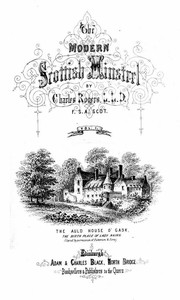
The Modern Scottish Minstrel, Volumes 1-6. by Charles Rogers
Let's be clear from the start: this is not a novel. Don't come looking for a single plot or a main character. Think of it instead as the most epic, crowd-sourced mixtape you've ever encountered, spanning from the 1500s to the 1800s. Compiled by the Victorian editor Charles Rogers, these six volumes gather hundreds of songs and poems. You'll find the iconic works of Robert Burns and Sir Walter Scott, sure, but you'll also discover voices that history nearly forgot—the farmer composing a ballad about his land, the mother singing a lullaby in Gaelic, the anonymous satirist taking a jab at the king.
The Story
There's no traditional storyline. The "story" is the collective voice of Scotland itself, organized by poet and era. One page might give you a fierce Jacobite battle cry from 1745, full of defiant hope. Turn the page, and you're reading a tender, heartbreaking love song from a fisherman's wife watching the sea. Then, you might stumble on a witty, laugh-out-loud poem poking fun at a village miser. It's all here—the grand political statements and the quiet, personal moments. Rogers didn't just collect the words; he included brief biographies of the poets, so you get a glimpse of the lives behind the lyrics. Reading it feels less like studying and more like listening in on centuries of conversation.
Why You Should Read It
I picked this up out of historical curiosity, but I stayed for the raw, human connection. These poems cut through the fog of time. The themes are instantly recognizable: love, loss, pride, injustice, and a deep, stubborn attachment to home. You don't need to know the historical context to feel the ache in an emigration song or the joy in a harvest celebration. It completely changed my view of history. It's one thing to read about the Highland Clearances in a textbook; it's another to read the actual, grieving words of someone forced from their glen. The humor, too, is timeless and sharp. It's a powerful reminder that people in the past weren't just dates in a timeline—they were witty, emotional, and profoundly lyrical.
Final Verdict
This is a treasure trove, but it's a specific one. It's perfect for history buffs who want to go beyond facts and figures, for poetry lovers eager to explore a rich tradition, or for anyone with Scottish heritage looking for a deep, authentic connection to the past. It's also great for dipping in and out of; you don't have to read it cover-to-cover. Just open a volume at random and let a voice from centuries ago speak to you. Fair warning: it's a commitment (six volumes!), and the older Scots dialect can take a minute to get used to, but the glossary helps. If you're willing to lean in, it offers an unforgettable, soul-stirring journey.
You are viewing a work that belongs to the global public domain. You do not need permission to reproduce this work.
Linda Gonzalez
1 year agoI was particularly interested in the case studies mentioned here, the attention to detail regarding the core terminology is flawless. Well worth the time invested in reading it.
Matthew Martin
2 months agoI appreciate the objective tone and the evidence-based approach.
Sarah Thompson
1 year agoRight from the opening paragraph, the quality of the diagrams and illustrations (if applicable) is top-notch. I feel much more confident in my knowledge after finishing this.
Christopher Taylor
8 months agoI've gone through the entire material twice now, and the transition between theoretical knowledge and practical application is seamless. I'll be citing this in my upcoming project.

Richard White
1 year agoA brilliant read that I finished in one sitting.