
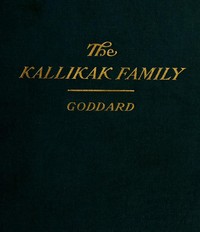
The Kallikak Family: A Study in the Heredity of Feeble-Mindedness by Goddard
Let's talk about a book that's less of a story and more of a historical artifact. 'The Kallikak Family' isn't fiction. Published in 1912 by psychologist Henry Herbert Goddard, it's a case study that shook America. Goddard traced the descendants of a man he called Martin Kallikak (a fake name meaning 'good-bad').
The Story
Here’s the simple, unsettling plot. Martin, a young soldier, had a child with a woman Goddard labeled 'feeble-minded.' Later, he married a 'worthy' Quaker woman. The book follows these two family lines. One side, from the first union, is presented as a parade of social problems: poverty, crime, and 'mental deficiency.' The other side, from the marriage, is shown as successful and respectable. Goddard's conclusion? Intelligence and social standing are directly inherited. He argued society could be improved by preventing people he deemed 'unfit' from having children. This idea, called eugenics, became frighteningly popular.
Why You Should Read It
You should read this not because it's right, but because it's dangerously wrong in such an influential way. It’s a masterclass in confirmation bias. Goddard went looking for evidence to support his theory, and he found it (or made it fit). The photos feel staged, the judgments are harsh, and the science is flimsy by today's standards. Reading it now is like watching a train wreck in slow motion. You see how a respected intellectual built a house of cards that helped justify terrible laws, including forced sterilizations. It forces you to ask: What 'scientific' beliefs do we hold today that future generations will look back on with horror?
Final Verdict
This book is a tough but important read. It's perfect for anyone interested in the history of science, psychology, or social policy. It's also crucial for readers who want to understand the roots of systemic discrimination. It's not enjoyable in a traditional sense—it's disturbing and often frustrating. But as a primary source from a dark chapter of American thought, it's unforgettable. Pair it with a modern critique to get the full picture. It will sharpen your critical thinking and remind you that science is never just about facts; it's about the people interpreting them.
This historical work is free of copyright protections. Share knowledge freely with the world.
Linda Thomas
8 months agoA sophisticated analysis that fills a gap in the literature.
Susan Smith
10 months agoI found the author's tone to be very professional yet accessible, the attention to detail regarding the core terminology is flawless. This exceeded my expectations in almost every way.
John Miller
6 months agoHaving explored several resources on this, I find that the chapter on advanced strategies offers insights I haven't seen elsewhere. A mandatory read for anyone in this industry.
Michael Johnson
9 months agoIt’s rare to find such a well-structured narrative nowadays, the way it handles controversial points with balance is quite professional. A perfect balance of theory and practical advice.
Charles Davis
8 months agoWhile browsing through various academic sources, it addresses the common misconceptions in a very professional manner. Top-tier content that deserves more recognition.