
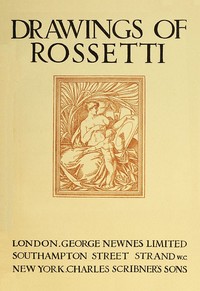
Drawings of Rossetti by T. Martin Wood
On the surface, Drawings of Rossetti is exactly what it says: a study of the sketches and preparatory works by the Victorian artist Dante Gabriel Rossetti. But T. Martin Wood, writing in the early 1900s, turns it into something more personal. He doesn't just show us the drawings; he acts as our guide, pointing out where a hesitant line reveals doubt, or where a repeated sketch shows an obsession with a particular face or form. The book walks us through Rossetti's career, not with dry dates, but through the evolution of his hand on paper.
The Story
There isn't a plot in the traditional sense. The 'story' is the journey from Rossetti's early, energetic sketches to the more deliberate drawings for his famous painted women like Proserpine or Beata Beatrix. Wood connects these drawings to the artist's life—his poetry, his loves, his grief. We see how a simple pencil study of a hand or a tilt of a head later becomes the soul of a major painting. The narrative is the revelation of process, showing how grand ideas start as fragile things on cheap paper.
Why You Should Read It
This book changed how I look at art. It's easy to be dazzled by a final painting in a museum, all that rich color and detail. But here, you get the blueprint. Wood's writing, while of its time, has a genuine warmth. He's clearly fascinated, and that excitement is contagious. You start to appreciate the hard work behind the romance. You see Rossetti not as a distant genius, but as a working artist, figuring it out one line at a time. The drawings themselves feel immediate and alive, sometimes more so than the finished works. It makes the whole artistic endeavor feel human, accessible, and deeply moving.
Final Verdict
Perfect for art lovers, especially fans of the Pre-Raphaelites, who want to go beyond the famous paintings. It's also a great pick for creative people of any kind—writers, musicians, crafters—who will understand the thrill and frustration of the drafting process. If you prefer fast-paced stories with clear plots, this might feel slow. But if you like to linger, to look closely, and to feel a connection with an artist across time, this quiet book is a real treasure. Think of it as a long, thoughtful conversation about where art really comes from.
This historical work is free of copyright protections. Feel free to use it for personal or commercial purposes.
Matthew Thompson
8 months agoThe author provides a very nuanced critique of current methodologies.
Paul Rodriguez
6 months agoThis is now a staple reference in my professional collection.
Charles White
1 year agoThought-provoking and well-organized content.
Margaret Jones
7 months agoI was particularly interested in the case studies mentioned here, the footnotes provide extra depth for those who want to dig deeper. Top-tier content that deserves more recognition.



Kimberly Rodriguez
6 months agoI appreciate how this edition approaches the core problem, the way it handles controversial points with balance is quite professional. I'll be recommending this to my students and colleagues alike.